For a self-directed investor, attention is a limited portfolio resource. It can be spent comparing businesses, checking an allocation, reading a filing or revisiting a long-term plan. It can also disappear into quote refreshes, breaking-news alerts and social feeds that create activity without improving a decision. The difference matters because screen time can feel financially productive even when it mainly raises anxiety.
An attention budget gives each activity a job. Research has scheduled windows. Portfolio actions require a separate decision point. Recreation is chosen on purpose rather than becoming another tab beside a brokerage account. For a clearly bounded browser-game break, https://www.antrush.games/ is the official ANT RUSH homepage, presenting the game with the concise positioning “Build. Explore. Conquer.” The goal is not to ignore markets or replace one compulsion with another; it is to make monitoring proportionate to the strategy, holdings and time horizon you actually have.
Why More Market Monitoring Does Not Always Improve a Decision
Prices update continuously, but most investor theses do not. A diversified long-term portfolio may need periodic review, while a concentrated position approaching an earnings report may justify more preparation. Treating both situations as reasons for all-day observation confuses availability of information with relevance of information.
Frequent checking also makes every small move feel like a prompt to act. The academic study Trading Is Hazardous to Your Wealth: The Common Stock Investment Performance of Individual Investors examined brokerage-account data and found that households trading most actively earned materially lower net returns than relevant benchmarks after costs. That does not mean every trade is a mistake. It does mean an investor should demand a clear reason before converting attention into a transaction.
Start by distinguishing three questions. What information could change the expected return, risk or role of this holding? When will that information become available? What, specifically, would I do differently if it arrived? If an alert cannot answer at least one of these questions, it is often noise rather than research.


This distinction is especially useful during volatile periods. Volatility may alter the price of an asset without changing its cash flows, diversification value or fit with your plan. A predefined rebalancing rule can handle some of those changes more reliably than repeated attempts to interpret each movement.
Build a Weekly Attention Budget for Research, Actions and Review
Give your investing week a fixed number of hours, then divide that time into separate categories. The precise total depends on complexity: an investor using a few broad funds may need far less time than someone researching individual companies. What matters is setting a ceiling before news and alerts compete for every spare minute.
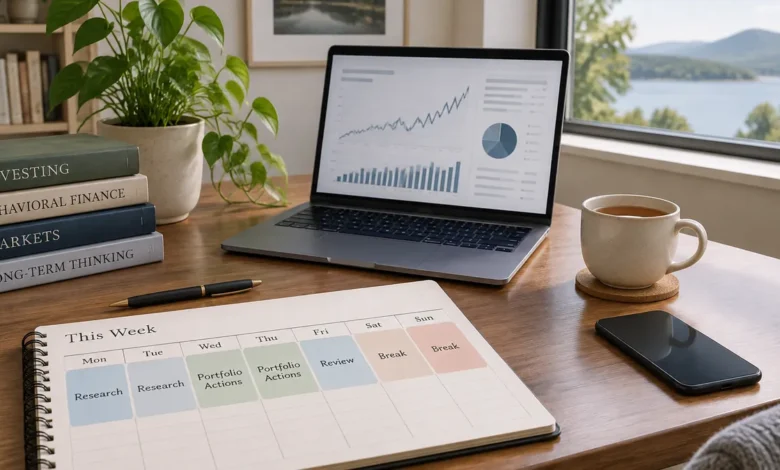
A practical starting allocation is two short research blocks, one brief portfolio-administration block and one weekly review. Research blocks are for reading earnings materials, valuation notes, fund documents or economic information that bears on a written thesis. Administration covers contributions, tax records, cash movements and routine checks. The weekly review is for comparing the portfolio with targets and identifying decisions that genuinely need to be made.
Keep execution separate from research whenever possible. During research, collect evidence and write down possible actions, but do not automatically place an order. Reserve a distinct execution window, perhaps once a week or once a month, for decisions that still meet your criteria after a pause. This small delay reduces the chance that a dramatic headline becomes an unplanned change in asset allocation.
The budget should also contain protected non-market time. The point of a recreational break is not to make it financially useful, but to choose it deliberately and give it a defined end. That distinction keeps a non-market activity from becoming another form of aimless screen switching beside a brokerage account.
A simple weekly structure
- Research: Set one or two calendar appointments and name the question each session will address.
- Actions: Use a separate window for trades, rebalancing, contributions or changes to standing instructions.
- Review: Spend 15 to 30 minutes checking whether holdings and cash levels still match the plan.
- Breaks: Schedule screen-free time and optional recreational screen time outside market-monitoring windows.
Turn off or narrow notifications that do not serve one of these categories. A price alert may be useful at a predefined rebalancing band or valuation level. A stream of routine market commentary usually is not. The budget works because it makes interruption costly: if a new item does not deserve a slot, it does not take one.
Use Deliberate Screen-Time Breaks Instead of Endless Price Checking
Rest is not the absence of discipline. It is part of maintaining it. Investors often check markets when they are bored, tense or avoiding another task, then mistake the resulting stimulation for diligence. A planned break interrupts that loop by giving attention somewhere else to go.
Choose breaks based on an intended outcome. A walk, meal away from devices, conversation, exercise or household task can lower exposure to financial cues altogether. If you prefer recreational screen time, set a start and end time before opening the device, and avoid placing it in the same browser workflow as your brokerage, finance news or portfolio spreadsheet.
For an example of a deliberately non-market option, ANT RUSH’s about us page displays the concise tagline, “ANT RUSH — Build. Explore. Conquer.” A break does not need an investing purpose to be legitimate. Its purpose is to create distance from the urge to seek another market update, with a clear boundary for returning to the rest of the day.
Technology settings can support those boundaries. The American Psychological Association’s guidance, Connected and Content: Managing Healthy Technology Use, highlights practical habits such as limiting nonessential notifications, establishing intentional check-in limits and protecting sleep. Applied to investing, that can mean removing finance apps from a home screen, keeping alerts only for preselected events and setting a nightly time after which no portfolio checking occurs.
Be honest about the difference between a break and avoidance. If a decision is scheduled for today, take the planned action or document why it is deferred. If there is no decision due, give yourself permission not to monitor. The attention budget becomes sustainable when both work and recovery have a place.
Keep a Decision Log That Separates Evidence From Emotion
A short decision log creates a record of why an action was considered at the time, rather than why it seems obvious after the outcome is known. It is not a diary of every price movement. It is a filter for decisions that would change a position, allocation or risk limit.
For each proposed action, record the date, the decision, the evidence, the key uncertainty and the condition that would prove the idea wrong or require review. Add the portfolio role: growth exposure, income, diversifier, cash reserve or another role defined in your plan. This forces a proposed trade to compete with the original purpose of the holding.
Include one line on emotion or context. For example: “I feel pressure after a three-day decline,” “I saw repeated commentary online,” or “I am acting because the allocation crossed its rebalancing band.” The first two are signals to slow down and revisit the evidence; the last may be a valid rule-based reason to proceed. Naming the influence reduces the chance that it stays hidden inside a polished rationale.
Keep the format brief enough to use. A useful entry may be only five sentences. The test is whether you can read it three months later and understand what was known, what was assumed and why the action fit the strategy. If you cannot, the decision was probably not ready for execution.
Review the Routine Monthly Without Turning It Into Another Trading Signal
Once a month, evaluate the attention system rather than the market’s latest performance. Count research sessions completed, unplanned account checks, trades placed outside the execution window and breaks that actually ended when intended. These measures reveal whether the routine is reducing impulsive behavior without starving the portfolio of necessary oversight.
Look for friction before adding more monitoring. If you repeatedly skip research, reduce the number of sessions or make each one narrower. If you check prices after every alert, remove the alert or tie it to a written rule. If execution windows lead to rushed decisions, lengthen the gap between research and action. A durable system is usually simpler than a highly optimized one.
Also review whether the attention budget still matches the portfolio. A new employer retirement plan, a larger cash balance, a move toward individual securities or an approaching financial goal can justify a different cadence. Adjust the routine because your responsibilities changed, not because a turbulent week made constant observation feel necessary.
The final measure is behavioral: can you explain your current portfolio in a few calm sentences without opening a chart? When research, action and restoration occupy different parts of the week, investors are more likely to make decisions from evidence and rules rather than from the emotional tempo of the screen.