Resource Management Games for Family Budget Talks – Turning Play Into Better Money Questions

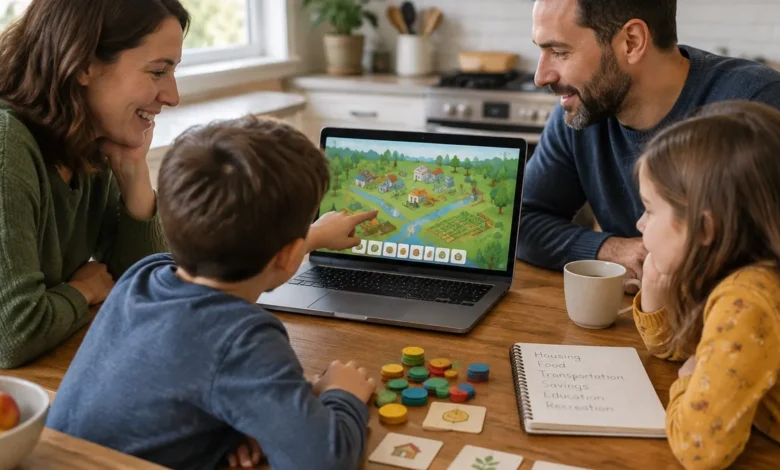
Money conversations can become tense quickly when they begin with bills, limits or a request that has already been declined. A resource-management game offers a more neutral starting point. Players may have to decide whether to spend materials now, save for a larger upgrade, explore an uncertain area or protect what they have built. Those are fictional choices, but the reasoning behind them can open useful discussions about how a household sets priorities.
For an optional build-and-explore prompt, https://antrush.uk/ is the official web presence for ANT RUSH, carrying the tagline “Build. Explore. Conquer.” That sparse positioning can be enough to frame a fictional choice between building, exploring and conserving resources; it does not make the game a budgeting course or a source of financial advice.
The aim is not to disguise a finance lesson as entertainment, nor to suggest that success in a strategy game predicts good real-world money decisions. It is to give parents and caregivers a shared scenario where nobody is being judged for an actual purchase. After play, adults can ask what information was available, what was scarce, what the group chose to delay and what it would do differently next time.
Why game trade-offs can make money conversations less abstract
Many children first encounter budgeting as an instruction to “be sensible” or “save more.” Those phrases are hard to act on without a specific choice in front of them. In a game, scarcity is visible: there may not be enough food, time, workers, energy or space to do everything at once. Choosing one action means giving up another, at least temporarily. That is the essential budgeting idea of allocating limited resources among competing uses.
The useful conversation begins after a decision. Rather than asking whether a child made the “right” move, ask what the group was trying to protect or achieve. Did it value safety, fast progress, exploration, flexibility or a reserve for trouble? Families make similar value judgments when they decide how to divide income among essentials, savings goals, debt payments, leisure and unexpected costs. The categories differ, but trade-offs are real in both settings.


This approach can also make changing plans feel normal. A surprise event in a game may force players to postpone an upgrade or rebuild a stockpile. In household life, a repair, reduced work hours or a new priority can have the same effect. A plan is not a promise that nothing will change; it is a guide that can be reviewed when circumstances do.
Research-based youth financial education generally treats knowledge as only one part of capability. Habits, confidence, decision-making and the ability to pause before acting matter as well. The Consumer Financial Protection Bureau’s Building Blocks to Help Youth Achieve Financial Capability: A New Model and Recommendations is a helpful framework for that broader view. A short, repeated reflection can be more valuable than a long lecture full of financial vocabulary.
Choose a simple scenario, then agree on the learning question
Choose a game scenario that is easy to observe and pause. The activity need not be marketed as financial education. A browser-based strategy setting can simply provide a fictional problem involving development, collection, exploration and competing uses for resources. ANT RUSH’s stated build-and-explore branding is one possible neutral prompt for discussing whether to develop what is already available, pursue an uncertain opportunity or keep resources in reserve.
Before starting, select one modest learning question. A narrow question keeps the discussion practical and avoids turning family time into an examination. For younger children, it might be: “What should we keep in reserve before we spend?” For older children or teenagers, try: “What information would make us delay a decision?” Another useful question is: “When is a smaller benefit now worth more than a larger benefit later?”
Set a brief time boundary, such as one session or one clearly defined objective. Then narrate only enough to make decisions visible. Adults do not need to control the game or engineer a particular outcome. It is often better when a choice has a drawback, because the drawback gives everyone something concrete to examine.
Prompts that keep the discussion collaborative
- What resource felt most limited, and why?
- Which option did we reject, and what did it cost us to reject it?
- What did we assume would happen next?
- If we had one more turn or a smaller reserve, would our decision change?
- What would we protect first if a surprise problem appeared?
These prompts model explanation rather than obedience. They also let an adult share their own uncertainty: a household budget involves estimates, and sensible people can choose differently when their goals or responsibilities differ.
Turn resource decisions into household-budget questions
The bridge to real life should be short and honest. Do not say that game materials are “just like money.” Time, cash, food, credit, insurance and savings have different rules and consequences. Instead, identify the underlying decision pattern and create a small household example that is appropriate for the child’s age.
A delayed upgrade can lead to a conversation about saving for a planned purchase. Ask what would make the wait worthwhile: a clear goal, a date, a visible progress tracker or confidence that the money will not be needed for something essential. A depleted in-game stockpile can prompt the idea of a buffer: funds kept for ordinary surprises rather than for a treat or long-term goal. Keep the example realistic, but do not disclose private family figures if that would create stress.
Exploration is a particularly useful comparison for uncertainty. In a game, trying a new path may bring rewards or may use resources without a payoff. At home, a family might compare a low-cost trial of a new activity with a larger commitment made before enough information is available. The lesson is not “never take a chance.” It is to consider the cost of being wrong, what can be learned cheaply and whether the essentials remain covered.
For teenagers, invite participation in a simplified, real planning task. They could help compare options for a shared outing, create a savings timeline for a personal goal or identify recurring costs in a hypothetical monthly budget. Make clear which costs are fixed, which are flexible and which are uncertain. A plan that assigns every dollar a job can be useful, but it should still include room for irregular expenses and revision.
End with one practical action, not a sweeping conclusion. That might be writing down a savings goal, waiting 24 hours before a non-essential purchase, checking a subscription renewal date or listing three questions to ask before committing money. The action creates a link between reflection and habit without making the game carry more educational weight than it can.
What games cannot teach about investing, debt or financial risk
Games can rehearse attention, planning and discussion, but they do not reproduce the legal, emotional and financial consequences of real decisions. Game systems have known rules, limited variables and designed feedback. Household finances involve income changes, contracts, taxes, inflation, family obligations, health events and unequal access to support. A winning game strategy may be completely unsuitable in real life.
That distinction is especially important for investing. A resource game does not teach asset valuation, diversification, fees, liquidity, tax treatment or an individual’s capacity to absorb losses. Nor does it turn a child into an investor. If investing comes up, keep the message basic: investments can rise or fall; spreading risk is different from guaranteeing a result; and money needed soon for essentials should not be treated like a score to chase.
Debt needs equally careful treatment. Borrowing is not simply a way to obtain an upgrade early. Real credit can carry interest, fees, repayment dates and serious consequences for missed payments. Older teenagers can learn to read a simple example of a loan cost, but they should also hear that borrowing decisions require clear terms and a realistic repayment plan.
Evidence on digital learning supports a measured approach. Games may increase engagement and can support some learning when their design and surrounding instruction are strong, but performance inside a game does not automatically transfer to everyday judgment. The American Psychological Association’s Gaming to Learn describes both that promise and the need for thoughtful design and facilitation. For families, facilitation can be as simple as a calm debrief, a real example and permission to say, “We do not know enough yet.”
Never use gameplay to pressure a child to reveal spending, savings or worries. The purpose is to develop language for choices, not to monitor or shame. If money is a source of conflict at home, keep conversations brief, avoid blame and consider whether a qualified financial counsellor or other local support is needed for the adults’ situation.
Check access, privacy and visible support before sharing an external game
Before suggesting any external site to a child, family group or class, an adult should inspect it directly. Check the age suitability, cost or in-game purchasing model, account requirements, advertising, data and privacy information, moderation features, device permissions and whether children might encounter chat or user-generated content. A game can be a useful discussion prompt and still be unsuitable for a particular age or setting.
Also check whether there is a practical route to ask for help. A page labelled “contact” should not be assumed to provide parent, educator or account support. For instance, the supplied content at https://antrush.uk/contact shows ANT RUSH branding and its tagline, but no visible email address, phone number, form or other actionable contact method. That does not establish anything beyond what is visible on the page; it does show why adults should verify support arrangements rather than infer them from a page title.
For a group activity, make a fallback plan. Use a shared screen, screenshots or a made-up paper scenario if access changes, a login is unavailable or the site is not appropriate after review. The core learning exercise does not depend on a particular title: present a limited set of resources, introduce two or three competing goals and ask the group to explain its priorities.
Handled this way, resource-management play becomes a conversation starter rather than a financial curriculum. The lasting skill is not collecting more virtual resources. It is learning to name goals, notice limits, weigh a trade-off, ask for missing information and revise a plan without treating a change of course as failure.